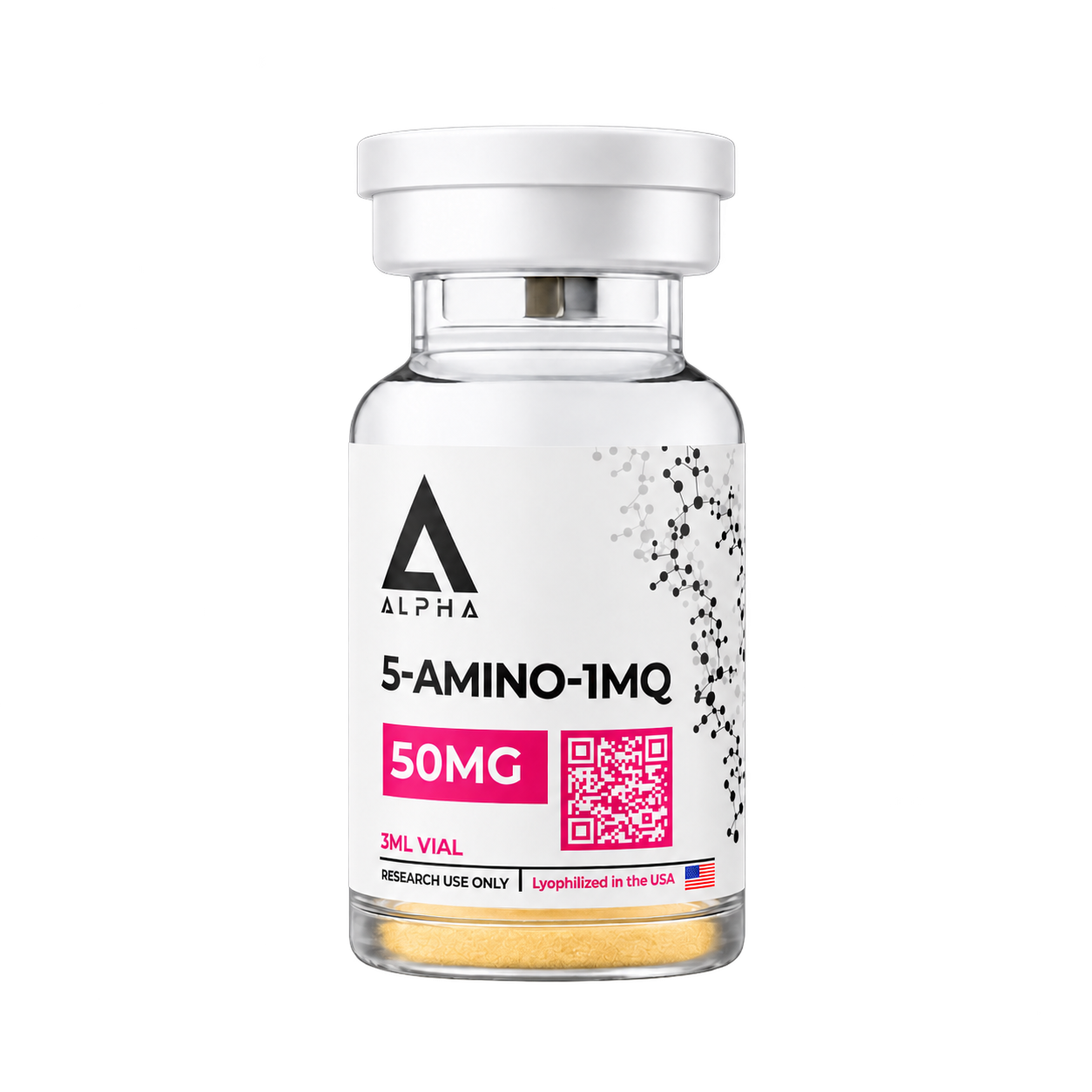
5-Amino-1MQ is shorthand for 5-amino-1-methylquinolinium, a small molecule investigated as an inhibitor of nicotinamide N-methyltransferase, or NNMT. Published research includes enzyme assays, cultured cells, rodent metabolism, and muscle-injury models. The studies reviewed here are preclinical. They provide research hypotheses and experimental measurements, not proof of human fat loss, muscle growth, rejuvenation, or long-term safety.
Start with the mechanism, identify the experimental model, and keep the limits in view.
01
NNMT as a research target
NNMT transfers a methyl group to nicotinamide and other substrates. A medicinal-chemistry study explored how changes to quinolinium structures affected enzyme inhibition. Enzyme potency is an early pharmacological measure; it does not by itself establish tissue exposure, selectivity throughout a living organism, or a clinical outcome.
Cell and mouse experiments examined whether inhibiting NNMT changes metabolites and adipose biology. A later obesity-model study also measured glucose-related outcomes, liver pathology, and tissue distribution. These endpoints help test the mechanism, but responses in laboratory mice cannot establish the magnitude or safety of an effect in people.
A separate study investigated an NNMT inhibitor in aged mice after experimentally induced muscle injury, with supporting muscle-cell experiments. Researchers measured stem-cell activity and regeneration. Injury recovery in this controlled model should not be rephrased as proven muscle growth, recovery enhancement, or age reversal in healthy humans.
Research findings apply to the exact compound, formulation, population and endpoints tested. They do not establish the identity, quality, clinical suitability or performance of a supplier’s product. This reference provides no dosing or administration guidance.
Start with three questions.
01What was tested? Check the exact molecule, sequence, composition and formulation.
02Where was it tested? Cells, animals and clinical populations answer different questions.
03What was measured? A pathway signal is different from a demonstrated clinical outcome.
03 / Selected publications
Go straight to the source.
Original records, study models and the limits that matter when interpreting a result.
STUDY 01 · 2017 Enzyme inhibition assays and molecular docking
The investigators identified quinolinium compounds with low-micromolar NNMT inhibition and related chemical features to measured activity. Docking supplied a proposed explanation for interactions at the substrate-binding site.
Reading limit: These assays characterize compound-target interactions. They do not establish an effective or safe human intervention.
An eleven-day mouse proof-of-concept experiment reported lower body weight and adipose measurements after 5-amino-1MQ exposure. Supporting cell work examined permeability, selectivity, and metabolic changes.
Reading limit: The experiment was short and used a specific animal model and formulation. It cannot establish sustained human weight change or long-term safety.
Researchers reported less weight and fat-mass gain and changes in glucose tolerance, insulin-related measures, and liver outcomes. They also measured exposure and tissue distribution.
Reading limit: These are preclinical outcomes. They do not validate a human treatment claim or show equivalence between commercial preparations.
Quick answers for reading the science behind 5-Amino-1MQ.
Is 5-Amino-1MQ a peptide?
No. The parent chemical entity is a positively charged quinolinium small molecule. Its placement within a peptide-oriented catalog does not change its chemical class.
Why distinguish the cation from a salt?
The identity values below describe the parent cation. A salt includes a counterion and has a different formula weight. Research interpretation requires the exact material, rather than relying only on the shorthand name.
Has oral exposure been measured?
Yes, a rat pharmacokinetic study measured 5-amino-1-methylquinolinium after oral and intravenous administration. That supports an analytical and exposure finding in rats, not a validated human regimen or commercial capsule performance.
What remains unresolved for people?
The cited work does not establish human efficacy, long-term safety, or equivalent behavior across formulations. Animal endpoints and proposed mechanisms should remain identified as such when discussing the compound.
Continue your research
One compound. A wider research library.
Explore the complete 5-Amino-1MQ profile and related compounds in the Disguised Peptides research hub.